le tasting room

Loire wine tours, tastings, day trips from Paris & short breaks organised by experienced English wine trade professionals.

Thursday, 14 April 2011

Les sous-terrains at Chateau de Pimpéan

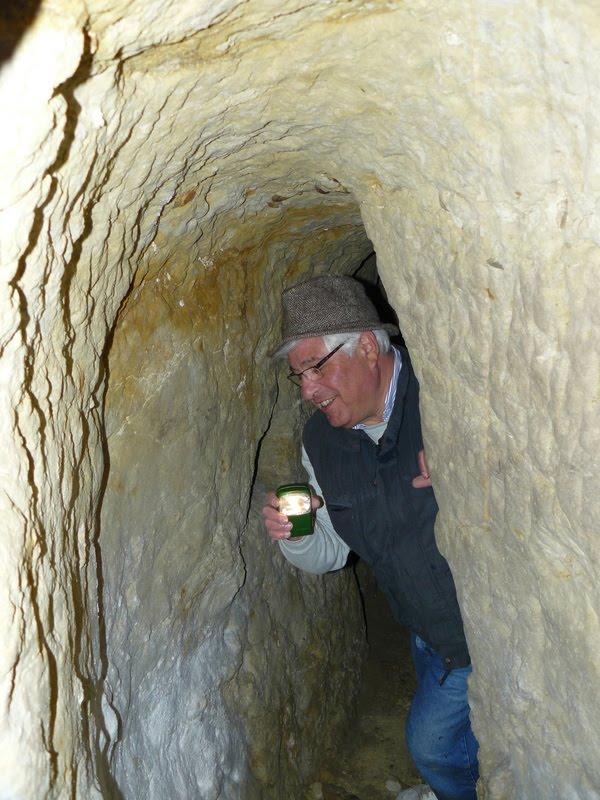
Maryse Tugendhat had been promising us for a while that we could go down and have a look at the sous-terrains under Chateau de Pimpéan. Last night, we donned our scruffy gear and went down for the first time. The entrance to the network of tunnels is barely visible above ground, a series of slate slabs covers the hole which is located a short distance away from the chateau itself. We weren't quite sure what to expect and in fact I was initally a bit of a weed as once we had uncovered the entrance we were faced with a narrow well-like tunnel into which we lowered the biggest ladder we could find in the winery. The ladder was not long enough to reach the top so it required a 'leap of faith' and a little clinging on to the narrow metal bars that straddle the opening before your feet made contact with the ladder.

Here's a short video that shows us opening up the entrance. I couldn't take any video after this point but managed to hang the camera around my back while I went down the ladder so took some photos once down in the tunnels.


Dropping the ladder down the entrance tunnel

Spencer was the first to go down

Incredible - a whole series of vaulted tunnels all interlinking


Looking back up at our support team

You can see from the size of the ladder just how deep it is

Places to rest, sleep and eat are carved out of the tuffeau


And afterwards, fresh fouasses cooked in the ancient oven at the chateau

All washed down with a glass of Crémant and some Chateau de Pimpéan Cuvee Passion 2005 of course which was tasting delicious


And this is how it looks normally, a tiny area covered with a few slate slabs.

Chateau de Pimpéan was a Catholic stronghold during the French wars of religion during the 16th century and these tunnels and galleries were used to provide a safe place for those seeking refuge. Many of the galleries are no longer accessible but it's incredible to see what lies deep beneath the ground so many years later. A really amazing insight into life in ancient times.


Sunday, 10 April 2011

The Sunday Brocante at Montsoreau

A few pictures taken today at the brocante in Montsoreau. We enjoyed a glass of Crémant watching the world go by and pottered around by the riverside for a while just enjoying the atmosphere. While I'd love to tell you that the only reason for visiting the Loire is to discover it's wonderful wines, that would be fibbing. There are hundreds of other things to enjoy while you're here and the traditional French brocante is one of them.


This is the Amarante - a restaurant boat that operates regular trips along the river during the summer months.

It can be a bit boring being a stallholder so best to bring a good book just in case!


And when you look around and find that suddenly the stallholders are enjoying a glass of wine, some terrine de foie gras and a large platter of seafood - you know you're in France. It's lunchtime and nothing will get in the way of a good meal.


The brocante in Montsoreau takes place on the 2nd Sunday of each month and there is a small market every week selling a selection of vegetables, fruits, seafood, charcuterie and flowers.

Thursday, 7 April 2011

Petite Cité de Caractère - Le Thoureil

It was such a beautiful morning I couldn't resist walking down to the river. Here are a few photos that I took - it's 8am and the sun illuminates everything in such a lovely way, highlighting the tuffeau limestone of the houses along the riverside and the old boats on the water.

Most of the houses along the riverside have these wonderful terraces which enjoy spectacular views over the river Loire.


Walking down Creuse rue to the river.

This little pathway runs high above the riverside houses giving you a glimpse of the terraces.

This is the Tour des Hollandais built by the Dutch Van Voorn family around 1670. They were négociants in wine and made their fortune in Le Thoureil becoming important vineyard owners, transporting their wines to Nantes and further afield using the waterways. These towers were built so that the merchant owners could watch their wares going along the river.

View of Le Thoureil looking towards Gennes (5km away).

This the lovely terrace of the Tour des Hollandais with the tower dominating the view.

This is l'Hotel des Mariniers - a former hotel (during the 15th century and after) which used to accommodate merchants and fisherman who were using the ancient port. The tower dates back to the 14th century.

Boats on the river Loire at the Cale de Richbourg -( little quay).

Another view of l'Hotel des Mariniers with it's 14th century tower.


The school in Le Thoureil - it has one class of CM1 & CM2 children (numbering between 12 and 30 depending upon the year). The canteen has amazing views over the river.


Waling down to the riverside you pass a couple of vineyards that look lovely in the early morning light.

The vines are pushing now and the shoots are beginning to form in this beautiful weather.

Bicyles propped up outside one of the lovely riverside houses.


View from vineyard just before descending to the river.

From the top of the hill where I shot the video yesterday. This morning you can see the bridge at Les Rosiers sur Loire. It looks more like a painting than a photo.


Vines in the early morning sunlight.

If you join us for the la Loire - Secrets of the River tour this year, Le Thoureil is where the old sand dredging boat is docked ready to welcome us during the afternoon. Alain Gillot is an experienced mariner and a local man who knows the history of this ancient port as well as that of the river itself.

Wednesday, 30 March 2011

Mathieu Vallée of Chateau Yvonne in Parnay - Saumur-Champigny

A few photos taken yesterday during a visit to see Mathieu Vallée of Chateau Yvonne. Mathieu used to be an engineer and initially resisted the urge to become involved in wine like his father and brother. 5 years ago however he had a change of heart and today he owns Chateau Yvonne in Parnay - the heart of the Saumur Champigny appellation.

He has 28 small parcels within 3 different villages making up a total of 11 hectares (8 Cabernet Franc and 3 Chenin Blanc). Total production is around 25,000 bottles on average.

He has one person helping him in the vineyard on a full-time basis and they do the pruning together. He finished this week - late by some standards but he was keen to point out the benefits of pruning late in terms of frost protection.


We enjoyed a tasting in his delightfully rustic tasting room, located in front of his winery which is hewn out of the tuffeau limestone.

Our thanks go to Mathieu for welcoming us at a time when he should probably have been at home (he was celebrating the birth of his second baby only a couple of days ago).

Tasting notes to follow.

Chateau Yvonne
16 rue Cristal
49730 Parnay
Tel 02 41 67 41 29
chateau.yvonne@wanadoo.fr

Monday, 21 March 2011

Chenin Blanc & the delights of the quince

When wine tasting we often try to recognise aromas in wine and one of the most commonly cited aromas in Chenin Blanc is quince. This old fashioned fruit is similar to the pear - knobbly and impossible to cut, it has a similar aroma although a little more exotic.

I had a quince tree when I lived in the South of England and despite being a keen cook, never did anything with the fruit giving them instead to my elderly neighbour who made them into quince jelly. Preserving is a bit old-fashioned - at least that's what I thought before I moved to France.

Here, it seems everybody makes jams, jellies and preserves. Fruit from the garden is eaten fresh in season and preserved for the winter months. I was given a few kilos by a friend this summer and decided it was time to have a go.

Firstly, I peeled the quinces and put the peelings into a large demi-john along with a litre of eau de vie. Then, I cut the quinces up (shere brut force required here - they are rock solid) put the pips and cores in a muslin square and cut the remaining fruit into slices. All this went into a large casserole into which I poured enough water to cover, brought to the boil and simmered for several hours.
Some of the cooked fruit I put into a tart with a frangipane base, the remaining fruit I pureed, added sugar and boiled again to make quince paste. I strained the liquid remaining from the boiled fruit and added sugar making a jelly with this.

A bit of a fiddle you may say, and yes, I suppose it was, but for a few kilos of fruit that cost nothing I made delicous jelly to spread on fresh crusty bread or to serve with roasted meats, quince paste to eat with cheese, a most delicious take on a traditional pear tart with more colour and flavour and a bottle and a half of quince eau de vie that I decanted off the peelings only yesterday.

And, I am now able to recognise the aroma of quince in many of our delicious Chenin Blanc wines from the Loire valley. We are only able to pick up individual aromas if they are within our own experience. I think I've finally nailed it!