le tasting room

Loire wine tours, tastings, day trips from Paris & short breaks organised by experienced English wine trade professionals.

Sunday, 29 January 2012

A Winter Walk around Blaison Gohier

A few photos taken while walking around the pretty village of Blaison Gohier last weekend.  On a clear day you can easily see Angers in the distance.


Monday, 9 January 2012

A few Favourite Moments from 2011

A few favourite photos from 2011 that bring back happy memories.


Clos Cristal in the Saumur Champigny appellation is one of two unique vineyards planted by Antoine Cristal at the end of the 19th Century. He had a vision of producing high quality wine that stood up to the likes of fine Burgundy and thought this required more heat than the average Loire vineyard could produce. He came up with the idea of constructing a series of walls that were 60cm thick, planted vines on the north side of the wall, made holes through the walls and then trained the vines through the holes so that the foliage came out and was trained up against the south side of the walls. This labour intensive and expensive project was never copied by other producers in the region but the 2 original vineyards are still in operation and produce great wines that reflect the extra heat summation coming from the retained and reflected heat from the walls.

In July we were lucky enough to welcome the entire choir of Girton College Cambridge here in the cellar for a morning's introduction to the wines of the Loire valley. The choir was here as part of a busy tour taking in performances in Saumur, Angers and Nantes before a busy schedule in Paris. They treated us to a few bars at the end of the tasting, proof that wine and music are really made for each other.

Rablay-sur-Layon is home to many local potters who hold an annual marché des potiers each year. This rather chubby bear attracted my attention amongst all the wonderful hand-made arts and crafts.

The Loire was so low - hard to imagine how little water. At times we worried that we might not be able to take our regular boat trips with Alain Gillot, local toue sablière owner and wildlife expert. Forced to zig zag across the water to keep afloat and sometimes having to push ourselves off the sandbanks, our trips were always memorable and the river always majestic and beautiful. The lovely architecture of our local village Le Thoureil always takes on a different perspective when seen from the water.

500 Euros per square metre - that's what it cost to lay the hand-cut ardoise (slate) tiles used to replace the roof on the petite chapelle at Chateau de Pimpéan last summer. Expensive yes, but the craftsmenship involved is extraordinary and the end result beautiful. Wonderful to think that the slate used to secure the life of the wall paintings inside the chapel were quarried and fashioned from the working mine in Angers only 20 minutes away.

One of many happy days spent with clients from around the world. We always spend the morning tasting and discussing a range of wines from all over the Loire valley and this was a particularly good day when the chemistry was just right and we came away friends.

Crémant is big in the Loire (the number 2 producer of traditional method sparkling wines outside of Champagne). I particularly like this shot that I took while visiting Langlois Chateau in St Hilaire St Florent just outside Saumur. It shows the yeasty sediment in a bottle of Crémant rosé sitting patiently in the neck of the bottle. The next stage will be to keep the bottle in this position, dip it in a freezing solution, pop it back the right way round, remove the crown cap and watch the frozen pellet shoot out the top. Then it will be topped up, corked, muzzled and 'dressed' ready for the market. A truly great product.

Cabernet Sauvignon grapes in the Croix de Mission vineyard owned by the Lebretons of Domaine des Rochelles. What an extraordinary year it was - budburst nearly a month early, no rain for months, no hint of summer sun, torrential rain and then - a late burst of glorious heat that ripened these grapes to perfection. Not a hint of disease in sight. Growers in Anjou were celebrating - perfectly healthy grapes, great sugar levels and ripe tannins. Although a difficult year for some, watch out for some lovely reds in 2011 with great fruit and lovely concentration.

Pierre-Jacques Druet in Benais (Bourgueil) always give us a fantastic welcome when we have the time to visit him and we love his very elegant reds from the Cabernet Franc grape. I called him to see if we could pop in with clients during harvest 2011 and he invited us to spend the morning with him and enjoy a working lunch afterwards. What luck! The machine harvester was parked on the courtyard so our first treat was to climb up and take a good look while he explained how it worked. Then we were back in the winery sticking our noses in all the tanks while he explained the different stages of fermentation (maceration, pre-fermentation, mid-fermentation, fermentation finished, pressing off the skins) and also we saw him put his rosé juice into old barrels before they were whisked off to his troglodyte cellars a couple of kilometers away. Then - off the cellars ourselves to see how his unusual rosé is made by an ancient method called guillage. Old wooden barrels filled to the brim with slowly fermenting juice each one pushing out a froth of almost fluorescent pink bubbles. This rosé takes nearly 6 months to finish its journey from juice to wine.

Around 700km of cycle tracks around the Loire valley make it both a beautiful and safe place to get on your bike and enjoy the beauty of the region. This year for the first time we welcomed a group of cyclists from Loirelifecycling.com for a tasting and lunch in our cellar. After a 45k cycle ride through the countryside and along the river during the morning they swept down the drive ready for a glass of Crémant (and a large glass of water) before enjoying a relaxing wine tasting lunch. Terrines, patés, salads, cheeses and dessert were a welcome sight after the morning's exertion and to end the day on a perfect note, Jon Lethbridge who organises the tours came to load the bikes into the trailer and them into the car enabling everyone to relax and enjoy lunch without the thought of a return journey afterwards!

We always enjoy visiting Chateau de Pimpéan as it combines wine tasting with wonderful history and architecture. This photo was taken late in the season and I love the dramatic sky and the low sunshine that illuminates the pavilion.

The leaves have started to fall and yet the weather remains gentle and mild. Still warm enough to take a walk in late October without a coat, I took this while enjoying an afternoon stroll around the vineyards of the Coteaux de l'Aubance.

Mid December and the sun is still shining. We called in with friends to buy one or two bottles of Eddy Oosterlinck-Bracke's fabulous noble sweet wines from the Chenin Blanc grape. Eddy works along bio-dynamic lines and if ever anyone will convince you - it's him. Don't expect tales of dancing around the vines under the light of the full moon but real explanations as to why this approach is best for the vines. And this makes a fitting end to the year as his approach is one that I certainly agree with. It makes sense to give vines the chance to defend themselves naturally against predators and diseases instead of turning to chemicals and sprays. Maintaining a good soil structure full of living micro-organisms can only be good for the vine, good for grapes - and good for us.

Happy New Year 2012!

Sunday, 1 January 2012

A New Year's Feast

Enjoyed a lovely meal with friends to see in 2012 last night - a great opportunity to indulge a little and open a few interesting bottles.

We started with a spicy duck rillettes, smoked magret and foie gras served with fresh fig bread and pain d'epices. I'm not normally a big fan of pain d'epices but this was superb - dense and aromatic. It was superb with the Quarts de Chaume 2006, the ginger notes in the wine marrying perfectly and providing a great contrast to the rich smooth foie gras and spicy rillettes.

An amazing colour - rich, amber, honey, spices and ginger all combined with a beautiful lean streak of acidity. Just delicious - thanks to Ali and Jos for such a treat.


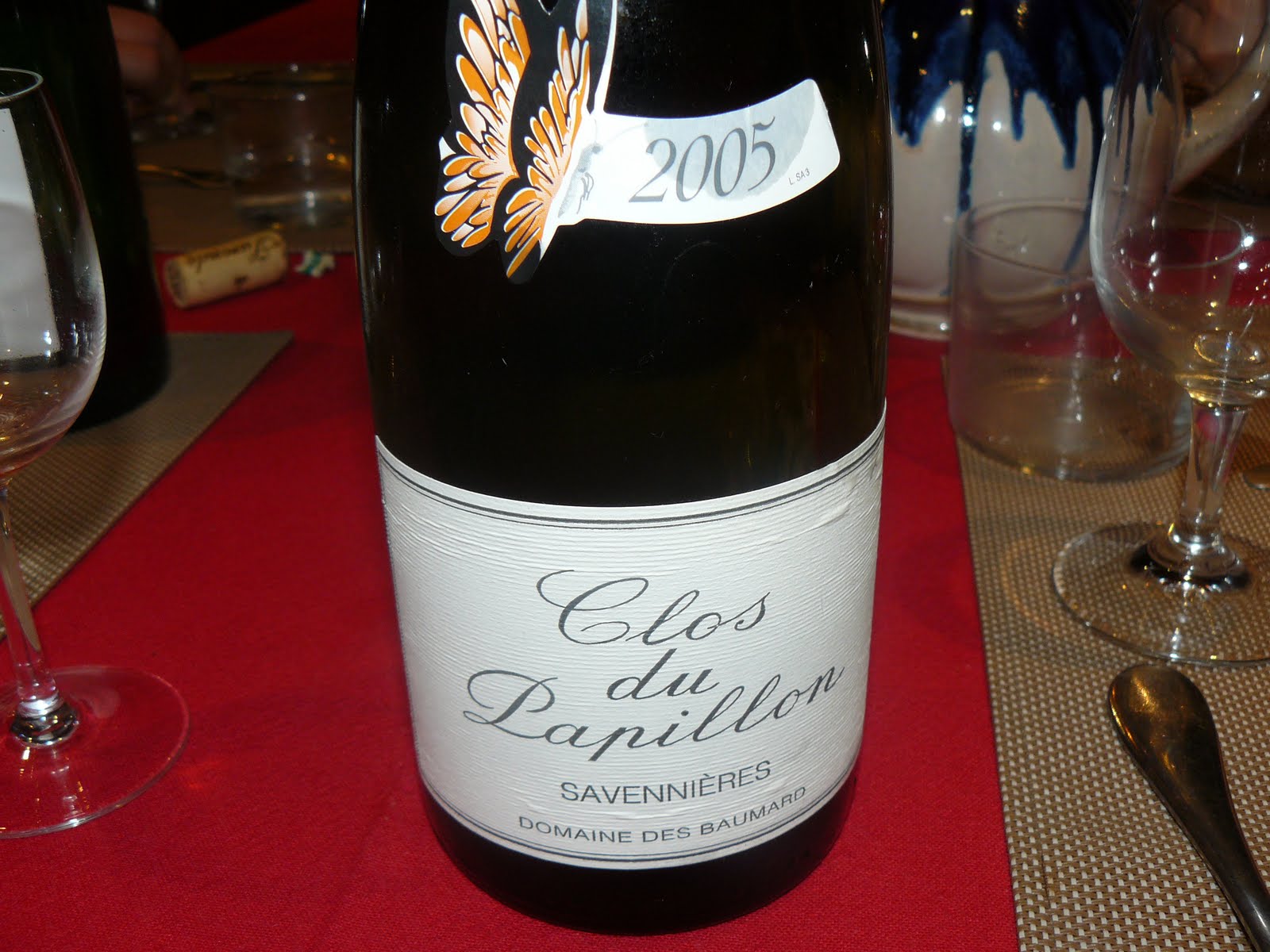
We followed with some scallops simply pan-fried with garlic, parsley and butter. I just love scallops - we don't eat them very often but they were wonderful. Sweet and tender with a hint of crispness on the outside. We drank a Clos du Papillon Saviennières 2006 from Baumard with them. Savennières comes in many different guises depending upon how it's been vinified, aged etc but Baumard's are clean as a whistle with a lovely precise minerality and not a barrique in sight. I'm a fan of the slightly oxidative style as well but do wonder why more producers don't make wines in this fresh, clean style which is more accessible to the average winedrinker.


Main course was a long slow cooked shoulder of pork cooked with sage, lemon, white wine and milk. A few simply roast potatoes and some carrots Vichy finished the dish. Simple flavours but tasty.


We drank two reds - firstly a 1998 Grand Mont Bourgueil from Pierre-Jacques Druet. I thought it was corked but was overruled by everyone else. Sometimes it's difficult when wines are showing tertiary aromas that come with age but I still think I was right! Pierre-Jacques' wines are normally full of elegance and fruit and for me this was ruined by a slightly stale cardboardy aroma. Just goes to show that we all have different levels of perception when it comes to cork taint. I've always been particularly sensitive to it but can understand the wariness to go out on a limb when others don't detect it to the same extent.


The second red we enjoyed was a bottle of Clos du Chene Vert 1998 from Charles Joguet. That was better - beautiful elegant fruit on the nose, a touch of leather and smoke and soft rich tannins that married well with the pork. Delicious.


The piece de resistance was the dessert. Inspired by his recent stage at the wonderful Auberge de la Sansonnerie, my 14 year old son and I spent hours fiddling around in the kitchen together creating the star anise sablé topped with a spiced pear fig and orange chutney, salted butter caramel ice cream and pear crisp. It was wonderful and a perfect finish to the evening (after the cheese).


With it we enjoyed a glass of Chateau Rieussec 1996. A real lanolin waxy hit on the nose was followed by rich honey and barley sugar notes. If I am brutally honest - I preferred the Quarts de Chaume that we enjoyed with the foie gras. We've obviously been living in the Loire valley for too long - the bias is setting in!

All in all a lovely evening spent enjoying good food with good friends and family. What more can you ask for for.

A very Happy New Year to you all. May 2012 be full of good things, laughter, good food, great wine and happy times.

Tuesday, 6 December 2011

A few Statistics from the Central Vineyards

Thanks to Jim Budd for posting the press release from Benoît Roumet of the Bureau de Centre. If you would like to read the full post in French you can find it on Jim's blog here but here are a few points that I took from it and translated into English.

'With a progression of 12% on the export market and an increase of 5% on the French market, the wines of the Central Vineyards have had a very successful campaign despite the environment of economic crisis.

At the end of July 2011 sales of wines from the Centre Loire had increased by 11% with more than 38 million bottles spread across the export and domestic markets.

Appellations with the highest profile are Sancerre and Coteaux de Giennois with an increase of 16% in the export of Sancerre white and 10% for the Coteaux du Giennois whites. Quincy's drop in exports has been compensated for by the French market. Other appellations have equally developed their sales with the exception of Reuilly which has seen a slight reduction of 2%.

A few figures

8 appellations make up the Central Vineyards: Sancerre, Pouilly Fumé, Menetou-Salon, Quincy, Reuilly, Coteaux du Giennois, Chateaumeillant, Pouilly-sur-Loire.

There are:
360 vignerons
35 négociants
5 Co-operatives

Production 2010 amounts to 42 million bottles of which 82% is white (up 10% when compared to the average of the past 5 years).

Sales over 12 months at the end of July 2011 were 38,1 million bottles of which 45% was exported to 110 countries around the world. Whites represent more than 92% of exports from this region.'

Friday, 2 December 2011

Domaine Cady Portes Ouvertes December 10/11

INVITATION à fêter notre 20ème WEEK-END DÉGUSTATION

les 10 et 11 décembre 2011

de 10 heures à 19 heures


C’est le moment de mettre en cave le fabuleux millésime 2010 :

un cru remarquable grâce à un terroir prodigue

ou de faire plaisir à votre entourage avec nos coffrets cadeaux.

Pour faire pétiller vos fêtes, n’oubliez pas les fines bulles de nos CRÉMANT DE LOIRE

Une bouteille ouverte est toujours un grand moment de convivialité !


Promotion : 12 bouteilles achetées la 13ème offerte

Pour affiner votre choix (descriptif et tarif des vins),

consulter notre site internet : http://www.domainecady.fr


Nos partenaires vous attendent pour vous faire

déguster leurs produits artisanaux en accord avec nos vins de terroir.


LA RUCHE VERNANTAISE : Miel et pain d'épice : 06-23-24-30-31

LA FERME DES ALPINES : Fromages de chèvre : 06-83-58-98-48

LES GOURMANDS DISENT : Chocolats : 02-41-54-09-56

M. AUDOUIN Laurent : Foie gras : 02-41-78-87-01


Espace enfants, Jeu, Buffet permanent

Un panier garni à gagner par jour

Monday, 28 November 2011

Pithon-Paillé Portes Ouvertes


Lots of good wine tasting opportunities this past weekend. We opted to pop in and see Pithon-Paillé with clients yesterday. Jo and Isabelle Pithon were manning the ship while Wendy and Joseph Paillé were down the road at the Anges Vins tasting.

Jo Pithon pouring samples and chatting to customers

Most producers hold open days at this time of year so it's a good opportunity to call in and taste the wines and maybe purchase a few bottles for the up and coming Christmas festivities.

Jo Pithon was on good form pouring samples and chatting to customers and the wines were tasting excellent, especially the Chenins. I loved the Belargus Coteaux du Layon - floral and honeyed with hints of citrus marmalade and with a fabulous stream of mouth watering acidity that hides the 200g of residual sugar. It has real class and is a tip top example of getting the sugar/acid balance just right.


The Quart de Chaume is excellent too but softer on the palate, a little more gentle with lower perceived acidity so although it also has 200g of residual, it seems sweeter. One of our clients asked Jo why it was not priced at a higher point than the Belargus bearing in mind its recent promotion to Grand Cru status. 'Because it's not better than the Belargus - they are of the same quality' he replied. What a great answer and an honest one - let the wines speak for themselves.

I also liked their Crémant de Loire which was on show for the first time. The 2009 base wine underwent a slow fermentation and was aged for a year before being mixed with unfermented grape juice from 2010 promoting the second fermentation. Jo explained that he was keen to make a sparkler but one that had the Pithon-Paillé identity and this certainly has it. Aromas of stewed apple and great minerality give it real complexity on the nose. If you like the slightly evolved style of Chenin then this is one for you.


Finally, anyone who has the guts to market a wine like this Grololo deserves to have success. A jeu de mots (play on words) - it refers to the grape variety from which it's made. Groslot (or Grolleau) is a work horse variety that is widely planted in Anjou, mostly for the production of rosé wines. A wine for friends and family this is not to be taken too seriously as indeed it is not. Full of juicy fruit, slightly peppery on the nose and with light tannins it's what we call a 'vin de soif' and was formerly their wine served at family meals during harvest time.

The term Grololo is a used to describe 'big breasts' hence the label. Jo Pithon laughs out loud as he explains its meaning to us and while there may be the odd one amongst you who may feel this is a little inappropriate I'm afraid everyone around him laughed along too.


Monday, 21 November 2011

Pre-pruning

Hard to believe with all this warm weather in November but yes, growers are already starting to prune their vines. In an ideal world they would wait for a decent cold snap to make sure the vines have had a dormant phase and viruses and diseases have been knocked on the head.

Practically speaking however, in many cases it's a question of the number of vines to prune, the manpower available and the deadline for finishing. So, pruning has commenced.

These pictures show the process known as pre-pruning. These blades sweep through the vineyard and make the 'first cut'. This allows the hand pruners to follow on with their secateurs (either electric or conventional). This second manual pass is the important one, where the pruner chooses the cane or canes (according to local tradition, appellation etc) that will bear the vine's fruit the following year.


There are two sets of circular blades that straddle the row of vines at the level of the top wire. The tractor passes slowly through the rows and the blades move out and around the posts. It's clever and saves a lot of time pulling and tugging canes that are stubbornly clinging on to the wires.